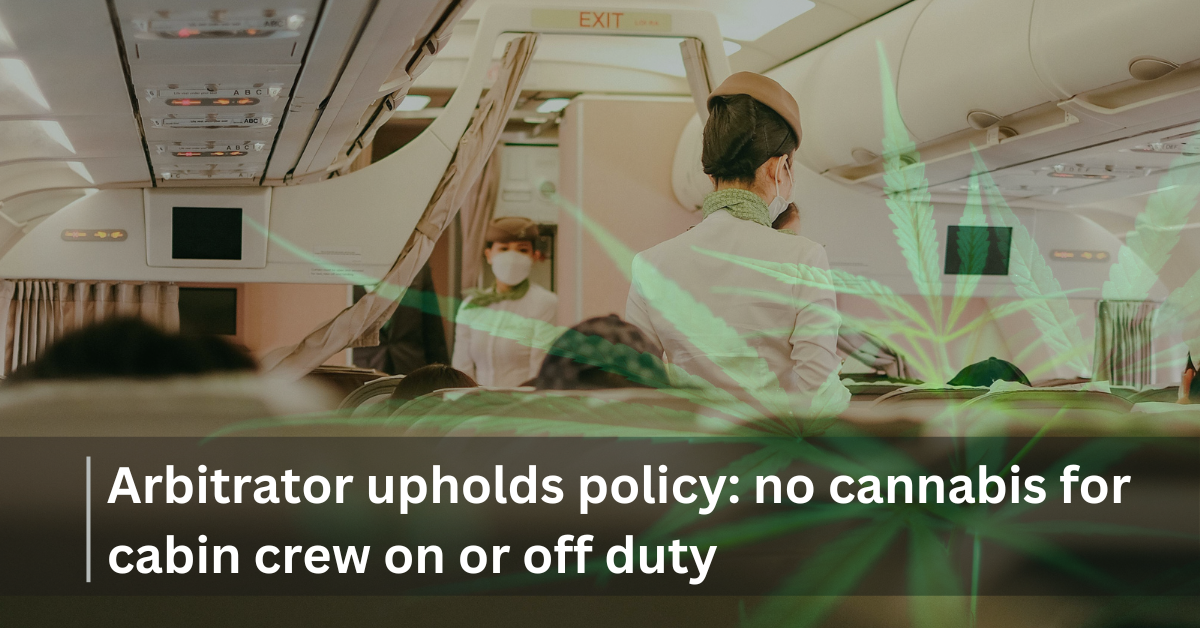
Earlier in May, a Quebec arbitrator upheld Air Transat’s zero-tolerance cannabis policy for flight attendants, finding that the restriction was reasonable despite prohibiting employees from using cannabis during their personal time. In Syndicat canadien de la fonction publique, section locale 4041 c. Air Transat (2026 CanLII 44306 (CA SA)), the arbitrator dismissed a grievance filed by the cabin crew union, which had challenged the policy following the legalization of cannabis in Canada.
Following the legalization of cannabis in 2018, Air Transat updated its drug and alcohol policy to prohibit all cannabis use by employees in safety-sensitive positions, including flight attendants, pilots, and maintenance personnel. While the union agreed that these roles were safety-sensitive, it challenged the blanket ban, arguing that it infringed on employees’ private lives and failed to account for differences between job functions. Air Transat maintained that the restriction was necessary to comply with aviation regulations requiring crew members to be fit for duty at all times.
Moreover, Air Transat’s experts testified that no reliable test can distinguish occasional from chronic cannabis use and emphasized the need for caution in aviation due to safety concerns. In contrast, the union’s expert argued that cannabis effects typically disappear within 8–12 hours, but the arbitrator gave less weight to this testimony because it relied on industry-funded research and was not provided by a physician.
By examining the established legal tests, the arbitrator concluded that aviation is a uniquely safety-sensitive industry that justifies stricter cannabis restrictions. It was determined that employees could remain affected by residual cannabis effects without showing obvious symptoms and determined that the policy’s impact on privacy rights was limited and justified. Finally, the arbitrator also declined to set a fixed abstinence period, citing the lack of reliable scientific standards, and noted that comparisons with the trucking and public transit sectors were not appropriate given the specific risks of aviation.