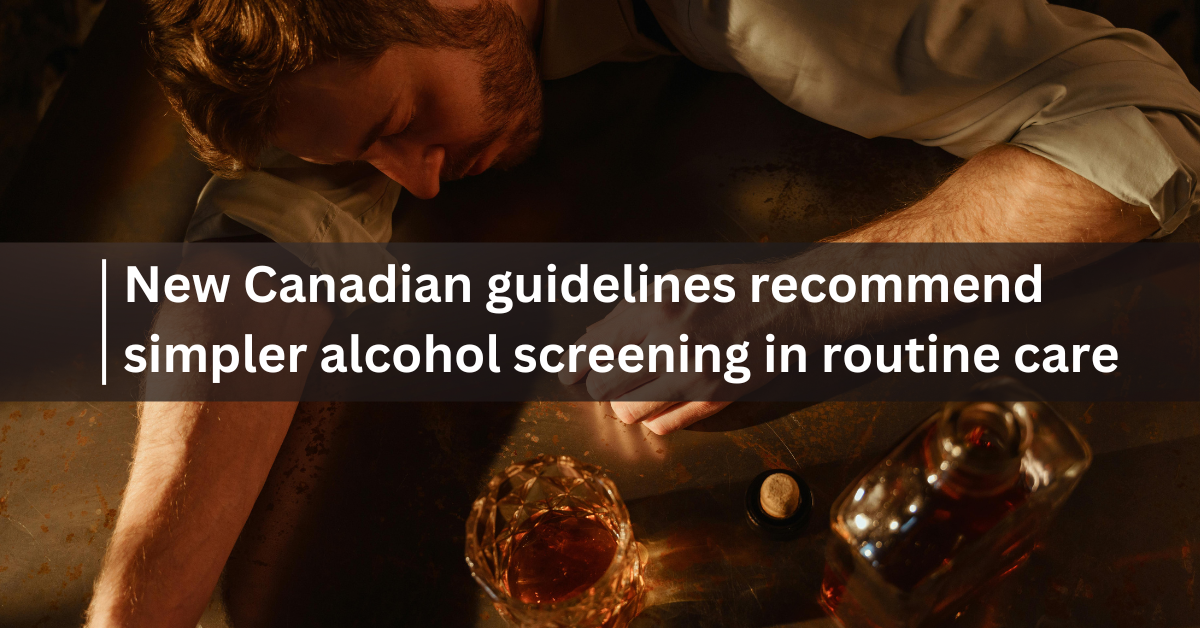
An updated clinical practice guideline published in the medical journal Canadian Medical Association Journal (CMAJ) recommends that healthcare providers should routinely screen patients for alcohol consumption above Canada’s low-risk drinking thresholds using a simplified, conversation-based approach. “Current screening tools for harmful alcohol consumption have fallen out of step with recent guidance on the health risks of alcohol,” reads the guideline. “To address this gap, the Canadian Research Initiative in Substance Matters updated the screening recommendations for high-risk drinking and alcohol use disorder (AUD) in the 2023 national clinical practice guideline.”
The updated recommendations were created by a multidisciplinary national committee, including individuals with lived and living experience, following a systematic review of studies on screening tools for high-risk drinking and alcohol use disorder published between 2013 and 2023. Moreover, the guideline used internationally recognized frameworks to evaluate the quality and strength of evidence and to ensure transparency, methodological rigor, and appropriate management of conflicts of interest.
Specifically, the guideline introduced five recommendations centered on a simplified screening approach that includes routinely asking patients about alcohol use, providing education to those exceeding the low-risk drinking thresholds, and guiding further assessment for possible AUD when appropriate. The five recommendations are as follows:
– Routinely screening all adults and youth for alcohol consumption above Canada’s low-risk drinking thresholds using a nonjudgmental, conversation-based approach.
– Providing brief education and reinforcement to individuals whose alcohol use remains at or below low-risk thresholds.
– Assessing individuals drinking above low-risk thresholds for alcohol-related risks, harms, and possible alcohol-related problems.
– Providing personalized advice and harm-reduction strategies to individuals drinking above the thresholds who do not report significant alcohol-related problems, without necessarily conducting a formal diagnostic assessment.
– Conducting a DSM-5 diagnostic interview for possible AUD in individuals who exceed low-risk thresholds and report alcohol-related problems or difficulty controlling their alcohol use.
“The revised screening recommendations represent a timesaving and pragmatic approach intended to be a resource for universal screening for alcohol risks and problems,” wrote the authors. “The recommendations streamline the process of identifying and addressing the health needs of those who consume alcohol in a hazardous way or may have more serious problems related to alcohol.”