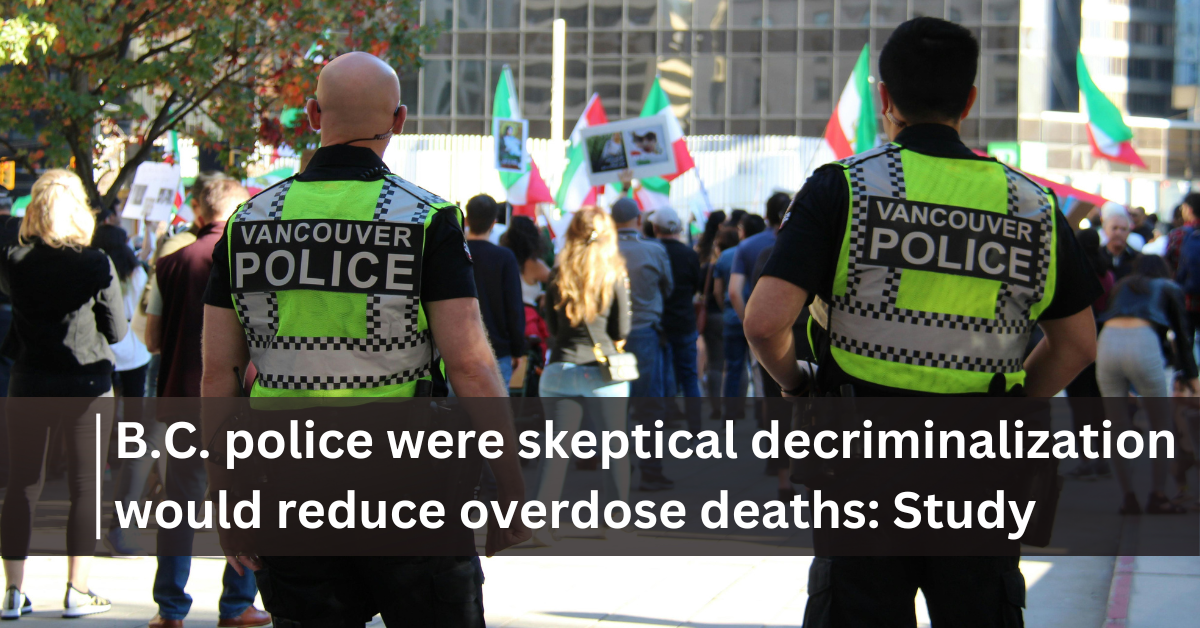
According to the results of a recent study carried out by Simon Fraser University (SFU) professor Amanda Butler, B.C. police officers were skeptical that the province’s drug decriminalization pilot program would be successful. As part of the survey, 30 police officers were interviewed in the province between November 2023 and March 2024, with 20 of the participants being constables on the front lines. B.C.’s three-year decriminalization pilot was aimed to reduce stigma, suffering, and overdose deaths by treating drug use as a public health issue rather than a criminal offence.
The results of the study were published in the International Journal of Drug Policy, and demonstrated that B.C. officers felt that criminal law reform alone would not be enough to decrease drug-related overdose deaths, and also that there was a need for better health and social services. “I don’t really think that you can improve the design and implementation [of a decriminalization project] without understanding the views of the people who are implementing it,” said Butler in her interview with CBC News. “Overwhelmingly, the police did not reject the intent or the overall goals of decriminalization, but they were quite skeptical of the policy itself,” she added.”Many of them said things like, ‘It was developed with the best of intentions, but without the health system capacity, we don’t think that it’s going to achieve its goals.'”
Although decriminalization aimed to reduce criminal penalties, many B.C. officers doubted it would significantly change legal system involvement because personal drug possession laws had already been minimally enforced for years. Butler also added that while the officers interviewed were largely united in their feelings of helplessness in making an impact in their communities within the context of the overdose crisis, there were some differences in how they viewed the goal of decreasing stigma around drug use. “Some actually felt that the policy might have the effect of increasing stigma … [due to the] increases in the visibility of drug use in some of the public backlash that was associated with that.”
Butler’s research also found that while some officers viewed stigma as a deterrent to drug use, evidence suggests stigma is ineffective for supporting marginalized people, and that decriminalization must be paired with investments in healthcare, treatment, housing, and social supports to succeed. Although the B.C. Association of Chiefs of Police initially supported the decriminalization pilot, it later withdrew its support, arguing that decriminalization alone could not address substance use challenges and should be accompanied by greater investment in healthcare and community support.
Moreover, a 2025 study found that individuals who use drugs were optimistic about decriminalization’s potential to reduce stigma, but also believed greater public education and expanded harm reduction services were needed for the policy to succeed. In her interview with CBC News, Farihah Ali, the first author of the study and a scientist at the Centre for Addiction and Mental Health, said it is part of a number of evaluations of decriminalization being conducted over the next two years.