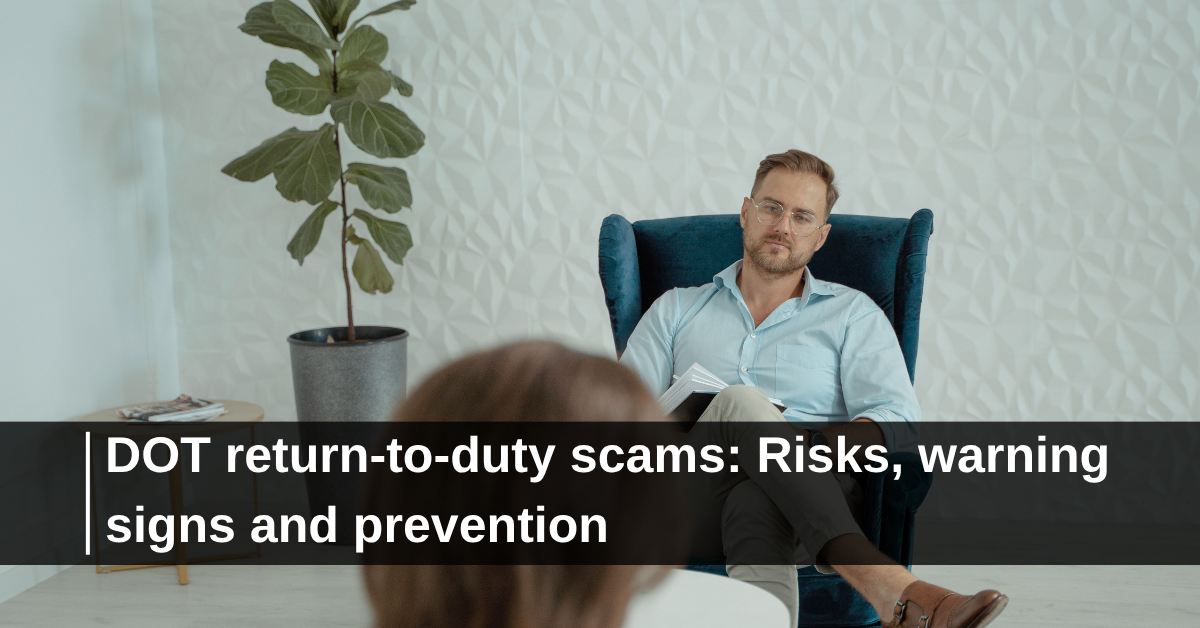
A recent analysis article published by the American Substance Abuse Professionals (ASAP) and authored by Sandra Serrano discussed fraud involving individuals posing as qualified Substance Abuse Professionals (SAPs) in the U.S. Department of Transportation (DOT) Return-to-Duty (RTD) process. Recent investigations have uncovered alleged widespread fraud involving individuals posing as qualified SAPs and third-party administrators within the FMCSA Clearinghouse. In addition, fraudulent SAPs reportedly cleared thousands of drug and alcohol violations without drivers completing the federally required Return-to-Duty process, raising concerns about regulatory compliance and public safety.
Moreover, the article also explains that employers may face regulatory violations, legal liability, audit findings, and enforcement actions if an unqualified SAP improperly conducts or documents an employee’s Return-to-Duty process. To reduce these risks, employers should verify SAP qualifications and ensure all RTD requirements and documentation are complete before allowing an employee to resume safety-sensitive work.
Using an unqualified or fraudulent SAP can invalidate the Return-to-Duty process and lead to delays, financial losses, CDL consequences, enforcement actions, and future employment difficulties. Fraudulent SAPs reportedly target drivers through social media with promises of fast, inexpensive, or guaranteed Return-to-Duty clearance, often requesting electronic payments and pressuring drivers to designate them in the FMCSA Clearinghouse. These operators may bypass required evaluations, falsify records, and, in some cases, demand additional payments by threatening to change or revoke a driver’s Clearinghouse status.
Finally, the article explains that employers must provide employees and applicants with a current list of qualified SAPs and ensure those professionals meet federal qualification requirements. Employers using third-party providers should also verify that their services support DOT-compliant SAP vetting and Return-to-Duty procedures.
“The Return-to-Duty process exists for a reason. While it may take time, it is designed to protect employees, employers and the traveling public,” concludes the article. “The best defense against SAP fraud is prevention. Review your internal processes for when a DOT drug and alcohol violation occurs, verify the qualifications of the SAPs on your list, educate employees about the warning signs of fraudulent services and work only with trusted compliance partners. A few extra steps today can prevent costly compliance failures and accidents tomorrow.”