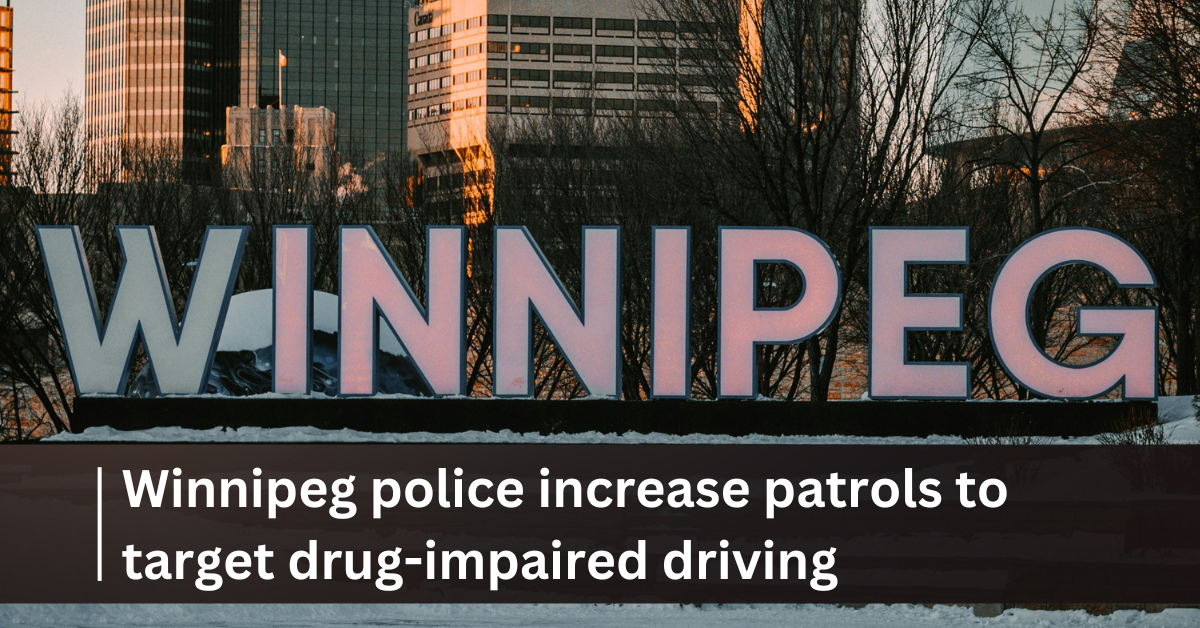
Earlier in January, Winnipeg police had announced it would deploy more officers in the coming weeks to reduce the incidence of impaired driving under the influence of cannabis and other drugs. Moreover, it will be partnering with Manitoba Public Insurance for the annual drug-impaired-driving enforcement campaign, which will run until March 1. “We want to start the year off right. We want to bring attention to this issue and hopefully prevent tragedies from happening on our roadways,” Const. Alex Peterson said at a press conference.
Officers with specialized training will be assigned to conduct random traffic stops of motorists whose behaviour raises suspicion, including in the vicinity of cannabis stores. In addition, minor traffic violations, such as failing to stop at a stop sign or driving unusually slowly, may also prompt a traffic stop. If officers detect the smell of cannabis or observe signs such as bloodshot eyes or slurred speech, drivers may be asked to provide a saliva sample. Furthermore, police will use approved screening devices to detect THC and cocaine.
Moreover, minor traffic violations, such as failing to stop at a stop sign or driving unusually slowly, may also prompt a traffic stop. Drivers may be asked to provide a saliva sample if officers detect the smell of cannabis or observe visible signs of impairment, such as bloodshot eyes or slurred speech. Police will also use approved screening devices to detect THC and cocaine.
So far, Winnipeg police have not revealed how many more officers will be deployed or where in the city they will be stationed. According to CBC News, in 2025, Winnipeg police carried out 302 traffic stops during the campaign, and 97 drivers tested positive for cannabis consumption, compared to 64 drivers who tested positive during 243 traffic stops in 2024. While alcohol continues to be the leading cause of impaired driving, cannabis was involved in about 20 % of impaired driving incidents last year.
“Because cannabis stores have increased, more people use it. But I am hopeful that by spreading the message … people will make arrangements for not driving impaired and allowing enough time to have it clear out,” Peterson said. According to Winnipeg police, drivers should avoid driving for at least 12 hours after consuming any cannabis product. Peterson also added that smoked or vaped cannabis can impair drivers within minutes, with peak effects around 30 minutes, lasting up to six hours, while edibles may take 30 minutes to two hours to take effect, peak within four hours, and cause impairment for 12 hours or longer, with tolerance varying by factors such as one’s age, complexion, and gender.