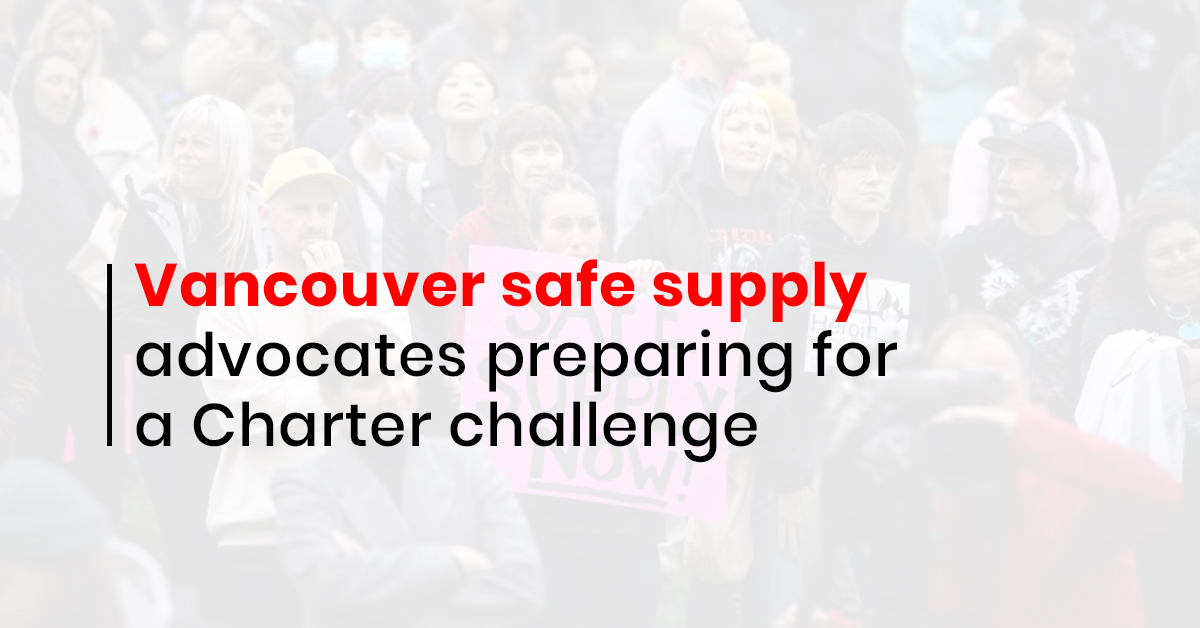
Vancouver-based safe supply advocates, the Drug User Liberation Front (DULF) and Vancouver Area Network of Drug Users (VANDU) is preparing for a second Charter challenge as part of its defence of its two co-founders, Eris Nyx and Jeremy Kalicum. In 2021, DULF and VANDU requested an exemption from Canada’s Controlled Drugs and Substances Act, in order to purchase heroin, cocaine, and methamphetamine on the dark web, test the drugs for dangerous adulterants and sell them to users through its “compassion club and fulfilment centre.” The groups’ request was rejected by Health Canada in 2022, while Nyx and Kalicum were arrested and charged with possession for the purpose of trafficking.
Earlier in March, lawyers representing DULF and VANDU appeared in court, arguing that Health Canada violated drug users’ Charter rights when it refused to grant the exemption for the group to create and run a legally sanctioned compassion. Furthermore, the legal team argued that the rejection was “unreasonable and likely to have caused harm and death to those at risk of overdose in Vancouver.”
Currently, DULF is preparing for its second Charter challenge. “We needed a compassion club. We needed somewhere for people to come who use drugs to get what they need in known potencies, quantities and quality and not be exploited financially, not be put at risk of violence and to not overdose,” Kalickum said in a previous interview with CBC News. “We’ve been forced into that position. We’re under no presumption that buying off the black market is a good thing.”
The DULF website has previously stated it had sold three kilograms of the drugs to compassion club members “for up to 80 per cent cheaper than they would [pay] on the street” and that among 42 program participants, there were zero known deaths resulting from the substances provided by the compassion club.
In addition, a published peer-reviewed research article co-authored by Nyx and Kalicim published in the International Journal of Drug Policy stated that enrolment in the compassion club was associated with a 49% decrease in the likelihood of non-fatal overdose, and a 63% decrease in the likelihood of non-fatal overdose involving naloxone administration.
According to the organization’s legal team, it is preparing to make a Charter challenge related to the criminal charges against Nyx and Kalicum, maintaining that imprisoning individuals providing uncontaminated drugs would infringe upon the life, liberty, and security of individuals who use drugs due to the high toxicity of the drug supply.
“The [Supreme Court] recognized that addiction is a health issue. It’s not an issue of moral culpability or a wilfulness or individual choice. It’s a health issue,” said Margot Young, a professor at the Allard School of Law at the University of British Columbia, in her interview with CBC News. “And that means that this larger context is one not of where you’re dealing with individuals who have a particular lifestyle, or they’re just making bad choices, but you’re dealing with individuals who have health issues.”
Moreover, Young added that it is difficult to know how the previous landmark decision by the Supreme Croute which allowed operation of the safe injection site Insite will affect the DULF cases, especially since it was not related to selling illicit drugs.
“That’s been of some concern with respect to opening other safer injection sites across Canada, although it has happened, and Insite does lead the way for that,” she said. “But to say that there’s an easy transference of Insite to this circumstance, I think, is probably not right.”