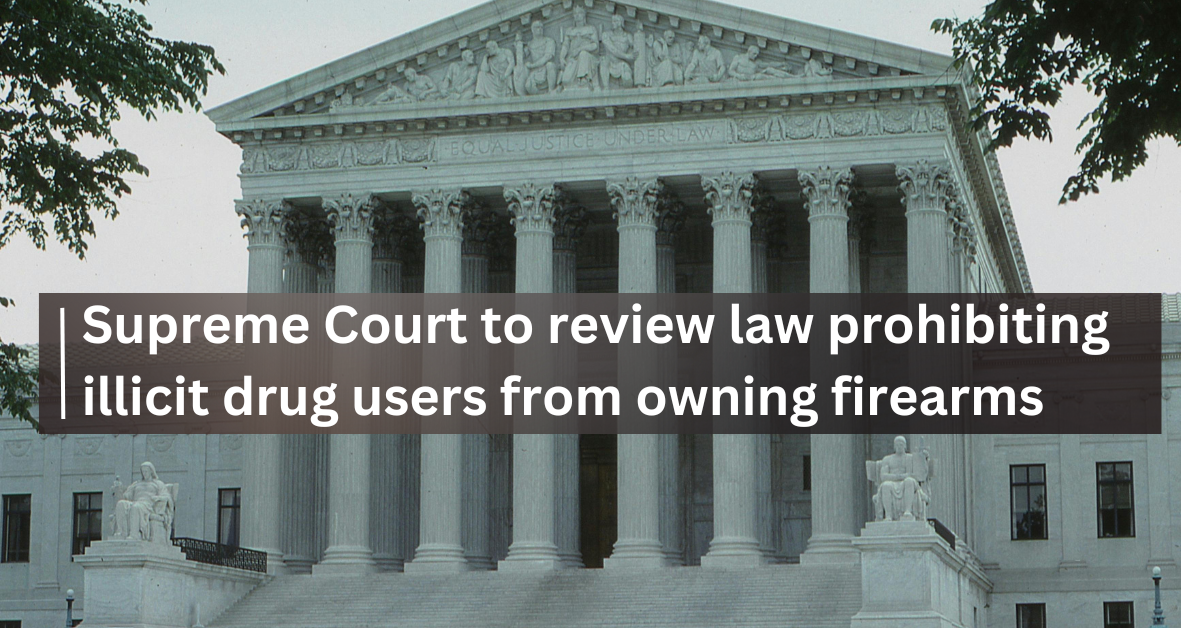
On October 20, the U.S. Supreme Court released a statement saying it will decide whether a federal law that prohibits individuals who use illicit drugs from having firearms violates the Second Amendment. The Trump administration has requested a review of the challenge to an appeals court ruling in favour of Ali Daniel Hemani, an alleged habitual cannabis user charged with violating the law. Moreover, this is the same law under which Hunter Biden, the son of former President Joe Biden, was convicted in June 2024, before his father granted him a pardon.
This case marks the second gun rights issue the Supreme Court has addressed in recent weeks. On October 3, the justices agreed to review whether a Hawaii law that places new restrictions on where concealed carry permit holders can bring handguns also infringes on the Second Amendment of the Constitution. The law in question is the latest firearm restriction to face scrutiny since the Supreme Court’s 2022 ruling affirming the right to carry firearms in public, which set a new standard for evaluating gun laws, with the Court upholding federal restrictions on guns for domestic abusers in 2024, but rejecting other cases.
The Republican administration has requested the court to reinstate a case against Ali Danial Hemani, whose lawyers successfully had his felony charge dismissed after the 5th U.S. Circuit Court of Appeals ruled that the blanket ban on firearm possession by illegal drug users is unconstitutional, citing the Supreme Court’s broadened interpretation of gun rights. However, the appellate court noted that the law could still apply to individuals found to be both intoxicated and in possession of a firearm.
Moreover, Hemani’s attorneys argued that the broadly written law risks penalizing millions of people, as at least 20% of Americans have used cannabis, and its federal illegality remains despite state-level legalization. The Justice Department defends the law, asserting that regular drug users, like Hemani, pose significant public safety risks, citing the discovery of a gun and cocaine during a search related to his alleged ties to Iran, while Hemani’s lawyers claim the unrelated allegations were meant to portray him as more dangerous.
Hemani’s case highlights the ongoing debate over the application of the Supreme Court’s 2022 decision, which established that the Second Amendment protects the right to carry firearms in public for self-defense, with restrictions needing strong historical justification. Following this ruling, numerous challenges to firearm laws have taken place, though the justices upheld a federal law prohibiting gun possession by individuals under domestic violence restraining orders.