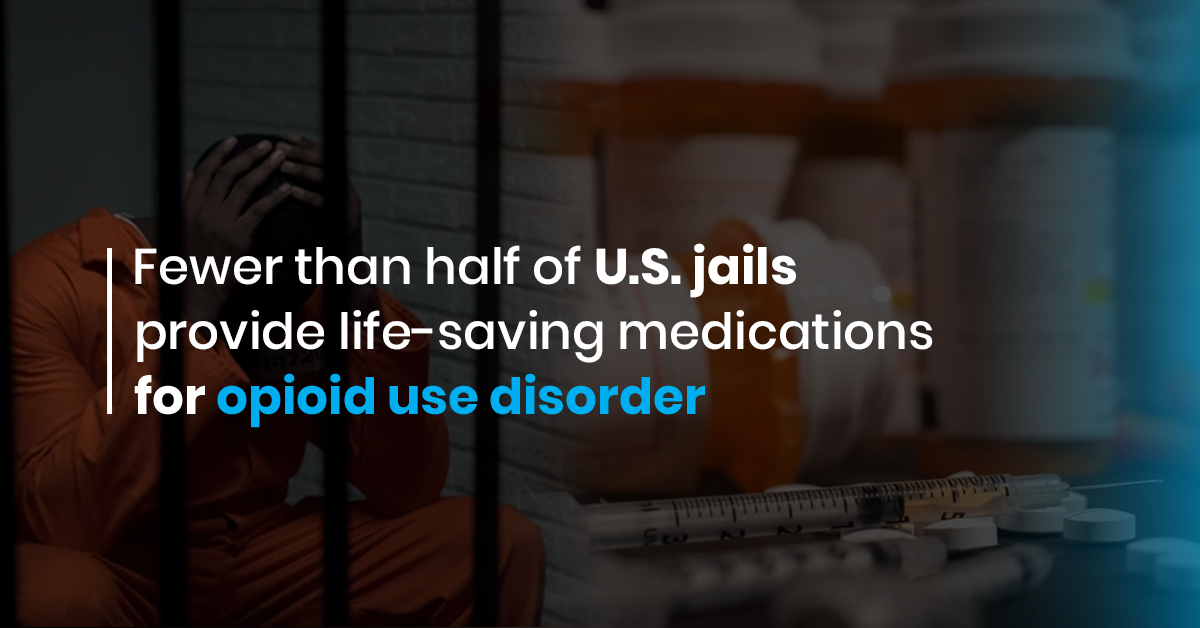
According to the results of a new study, only 43.8% of jails in the United States provide incarcerated individuals with essential medications to treat opioid use disorder medications, such as methadone, buprenorphine, or naltrexone. The research study, published in the peer-reviewed journal JAMA Network Open, was conducted by researchers at the National Opinion Research Center (NORC) at the University of Chicago, invited a random sample of 2,791 jails to participate in a survey on the availability of medications for opioid use disorder. The data was collected over the period spanning June 2022 and April 2023.
The findings of the study showed that the most common reason jails cited for not offering medications for opioid use disorder was the lack of adequate licensed staff, which was reported by 49.8% of jails. It was also found that larger jails, as well as jails in counties with lower “social vulnerability” (lower levels of poverty and unemployment, and greater education, housing, and transportation access), and those located within greater proximity to community-based providers of medications for opioid use disorder were more likely to offer treatments for opioid use disorder.
“Offering substance use disorder treatment in justice settings helps to break the debilitating—and often fatal—cycle of addiction and incarceration,” said Dr. Nora Volkow, director of the National Institute on Drug Abuse (NIDA). “Though someone may be in jail for only a short time, connecting them to addiction treatment while they are there is critical to reduce risk of relapse and overdose, and to help them achieve long-term recovery.”
Data released by NIDA also shows that approximately 65% of the U.S. incarcerated population suffers from substance use disorder. “Data on health care gaps for people who are incarcerated provides a necessary knowledge base to help policymakers, public health officials, researchers, and communities assess where to allocate resources to improve care for opioid use disorder for this population,” said Dr. Elizabeth Flanagan Balawajder, senior research associate at NORC of the University of Chicago and the study’s corresponding author. “Our findings suggest that supporting areas such as staff training, infrastructure improvements, and partnerships with community treatment providers are key areas to improve substance use disorder treatment for people in jail.”
Moreover, this study carried out the most comprehensive overview to date of the availability of medications used to treat opioid addiction in the U.S. Future research will also address the impact of providing these medications on health outcomes for the people in jail, as well as exploring disparities related to sex, gender, race, and ethnicity in the context of access to medications for opioid use disorder within the U.S. criminal justice system.