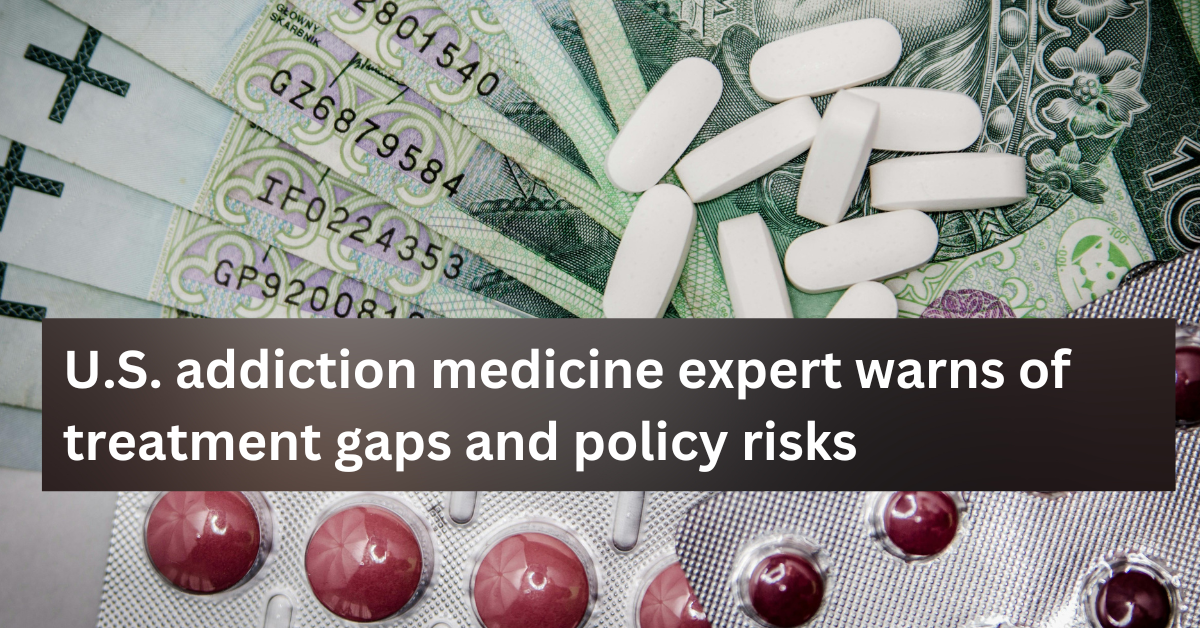
Earlier in October, Dr. Stephen Taylor, president of the American Society of Addiction Medicine, raised concerns and issued warnings on current Trump administration policies regarding substance use, low rates of addiction treatment uptake, and an increase in problem gambling at the STAT Summit in Boston.
“We’re still focused on what we’ve always been focused on, which is making sure that we can maximize and increase access to care for people who have substance use disorder,” said Dr. Taylor. “We’re talking about 48.4 million Americans who meet criteria for substance use disorder, at least as of 2024. Close to 90% of those folks, about 88% of those folks, do not receive treatment. So we’ve got a lot of work to do.”
In addition, Dr. Taylor expressed concerns regarding federal government funding lapses that had effectively shut down the Substance Abuse and Mental Health Services Administration (SAMHSA), the primary federal agency for addiction services in the U.S., and followed significant Medicaid cuts, which fund most addiction treatment across the country. He also disagreed with Health Secretary Robert F. Kennedy Jr.’s claim that 12-step programs are the “gold standard” for treating opioid addiction. However, Dr. Taylor also emphasized areas of common ground with Kennedy, highlighting his remarks at the Rx Summit in Nashville last April, where he acknowledged that medications such as methadone, buprenorphine, and the overdose-reversal drug naloxone are vital components of the nation’s opioid crisis response.
He also spoke out against the Trump administration’s use of involuntary civil commitment, which forces people with addiction or mental health conditions into treatment facilities without their consent. “What does the evidence say? There is no evidence that tells us the potential benefits of involuntary civil commitments outweigh the risks and the adverse effects,” Dr. Taylor said. “We’re not in favour of involuntary civil commitment as a way to help people with substance use disorder who happen to be homeless.”
Dr. Taylor warned about the growing problem of gambling, particularly with the increase of online sports betting platforms that let people place large wagers directly from their phones without ever setting foot in a casino. “People don’t necessarily think about it as a health problem, but it is,” he said. “Of all the different addictions, whether it’s heroin or cocaine or alcohol or other behavioural addictions, gambling is the one most closely associated with suicidality.”
Finally, he concluded his remarks on an optimistic note, highlighting the potential of GLP-1 medications, which are currently used to treat diabetes and obesity, as promising new tools for addressing addiction. He emphasized that the excitement around their use in addiction medicine is “not just hype.” “There is some really impressive-looking data — but it is preliminary data — that suggests it could be helpful for alcohol use disorder, and even tobacco use disorder and opioid use disorder,” he said. “The data is impressive, it looks promising, but it is preliminary, and I like to remind people that we already have FDA-approved treatments for alcohol use disorder that really should be the thing we’re trying to increase access for.”