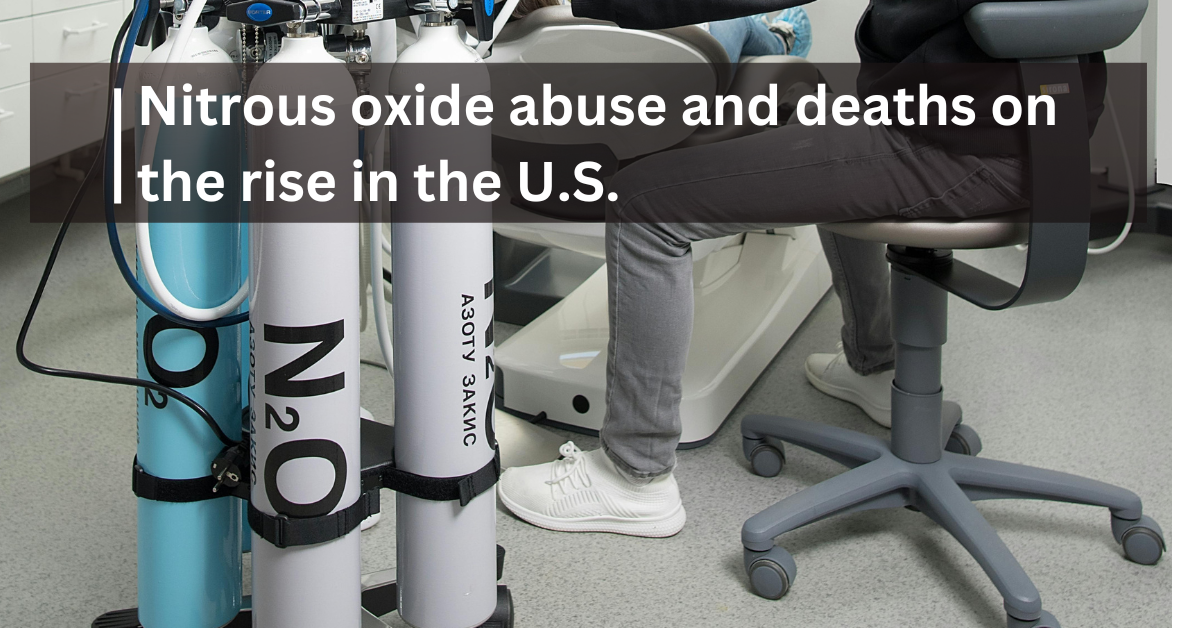
In recent months, U.S. researchers and health experts have voiced concerns over the increase in misuse of nitrous oxide, also known as laughing gas. Despite a recent warning issued by the Food and Drug Administration (FDA) warning against inhaling the drug, there has been a spike in deaths due to its abuse.
Nitrous oxide, which is also called “nitrous,” “laughing gas,” or “NOS,” is a colourless gas with applications in medicine, dentistry, and food processing. However, misuse of nitrous oxide has become increasingly common, particularly among young adults, due to its short-term euphoric effects. “It’s similar, for example, to drugs like ketamine. It’s dissociative and euphoric,” said Dr. Diane Calello, medical director of the New Jersey Poison Control Center at Rutgers New Jersey Medical School in her interview with Action News. She noted that in her office, she has witnessed nitrous oxide abuse cases nearly triple since 2021. “We do get calls about patients who use a lot of nitrous every day and, for example, develop neurological problems or spinal cord degeneration.”
According to the 2023 National Survey on Drug Use and Health, more than 13 million Americans have misused nitrous oxide in their lifetimes. What’s more, the number of deaths attributed to nitrous oxide poisonings has increased by more than 110% between 2019 and 2023, according to the Centers for Disease Control and Prevention (CDC).
When misused, consuming nitrous oxide can interfere with the body’s metabolism of vitamin B12, with long-term abuse potentially causing neurological and psychiatric complications. “This is a chemical that is commonly used as a sedative or anesthetic, but what we’re seeing is a rise in recreational use,” said Dr. Andrew Yockey, University of Mississippi assistant professor of public health, in his interview with Science Daily. “But what we’re also seeing is also a rise in hospitalizations, in poisonings and in deaths.”
Despite warnings issued by health authorities, nitrous oxide remains widely accessible and largely unregulated, and can be purchased online or at stores. “Think back to big tobacco; they deliberately targeted young people with cartoons, fun flavours and flashy colours,” Hoopsick said. “That is a parallel we’re seeing now with nitrous oxide,” said Dr. Yockey.
Health experts and researchers have stressed the need for more research to understand the impact of nitrous oxide misuse, as well as for changes to legislation in order to reduce harms related to its abuse. “Policy level interventions are what are lacking at the moment,” said Dr. Rachel Hoopsick, assistant professor of health and kinesiology at the University of Illinois at Urbana-Champaign. “If we have some guardrails on who can sell this, who can buy it and how it’s marketed, maybe we can get ahead of the problem.”